.
S
i t e S e a r c h
.
A_B_C_D_E_F_G_H_I_J_K_L_M_N_O_P_Q_R_S_T_U_V_W_XYZ
.
List
of Topics__Ask
Suby__Free
Stuff__Questions
Lists
Terms
of Use__________________Privacy
Policy
.
...from The LibertyBeacon.com
Two United States Constitutions
– 1789 and 1871
By David-William
Anyone who digs through
American history can find the District of Columbia Organic
Act of 1871, when the Crown/Vatican/Swiss Banking Cabal set up to rob
everyone of their rights to land, thanks to the Crown Temple B.A.R.
Broker/Attorneys who made sure to set it all up for their Jesuit.Rothschild
Lord and Master. Since then all we have known is war, bankruptcy and constant
struggles with these Banksters and their Judges and Lawyers. A brief account
of the history of the end of what we thought was liberty.
It's still possible to have liberty, but it's a constant conflict with
the loathsome
courts.(until
October 2025 that is, when the Maritime law they instituted to subjugate
people was displaced
by Trump, who returned the country to Common
Law, based on the most high true God).
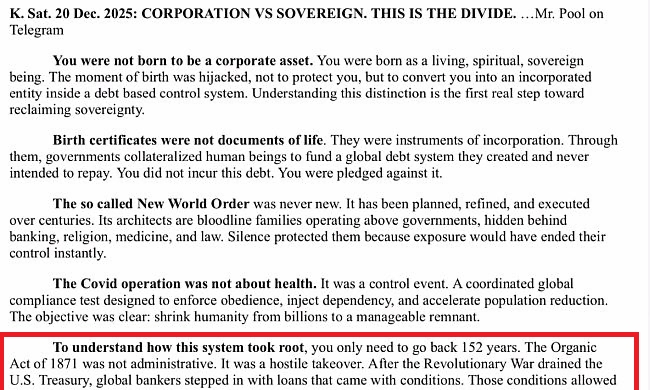
The UNITED STATES.(all
capital letters as here).Incorporated
in England in 1871 was governed entirely by private corporate law, dictated
by the banks as creditors.
The U.S. is coming out of
being a Crown Colony of England. The U.S. has always been and remains a
Crown.(Roman
Catholic Pope).colony.(until
it was changed for the benefit of the people by Trump).
King James I, is not just
famous for translating the.Bible.into.The
King James Version, but for signing the.First
Charter of Virginia.in
1606 — which granted America's British forefathers license to settle and
colonize America and was never based on We
the People's will. The charter.guaranteed
future German Roman Catholic Kings/Queens of England would have
sovereign
authority over all people and colonized land in America.(they
took the land, that is, they stole it).
See about Organic Act 1871.
After America declared independence
from the Crown, the.Treaty
of Paris, signed on September 3, 1783 was signed. That treaty identifies
the German Roman Catholic King of England as prince of U.S.
Prince George the Third,
by the grace of God, king of Great Britain, France and Ireland, defender
of the faith, duke of Brunswick.(Germany's
Brunswick).and
Lunebourg.(Germany's
Lunebourg),
arch-treasurer and prince elector of the Holy Roman Empire.(Roman
Catholic Church).etc.
and of the United States of America – completely contradicting.premise
that America won The War of Independence. Article 5 of that treaty gave
all British estates, rights and properties back to the Crown – Catholic
Church Pope.
The Congress realized that
the country was in dire financial straits, so they made a financial deal
with the devil – the Crown, a.k.a.
City of London Corporation – established
by the Catholic Church on January 1, 1855,
thereby incurring a DEBT
to the Pope. The conniving
Pope and his central bankers were not about to lend the floundering
nation any money without some serious stipulations.
So, they devised a way of taking
back control of the United
States of America and thus, the Act
of 1871 was passed. With no constitutional authority to do so,
a corrupted Congress created a separate form of government for the District
of Columbia.(Washington,
DC). While
the Fed was created by a corrupt Congress, its decisions are also made
by appointed aka selected officials,
not
elected ones — making it one of the most powerful unelected institutions
in the country.
The people of the 50 Union
states together maintain foreign sovereign immunity. First, an important
point needs to be made clear here. IN LAW, a fictitious.entity
can only deal with another fictitious entity, because only parties of
equal standing can communicate in law. Read that again!
The UNITED STATES.(all
capital letters as here).shows
incorporation
and that in England in 1871 by the rules the bankers & government there
set up to control the people and subgugate
them, because a financial default again loomed
and bankruptcy was
imminent.
So in 1871, the ten miles square was INCORPORATED
in England. They used the constitution as their bylaws,
not as authority under the original Constitution, but as authority over
the constitution. They CopyRighted,
not only the Constitution but also many names such as, THE UNITED STATES,
U.S. THE UNITED STATES OF AMERICA, USA and many other titles as their own.
This was the final blow to the original constitution. From here on out,
the UNITED STATES was governed entirely by private corporate law, dictated
by the banks as creditors. Never a concern for the dear people of the nation,
but all for 'me, me, me', being the politicians and bankers, the subjugators
of the people. And this was the case worldwide right up to today, but not
anymore, thanks to Trump and the military alliances.
More Bankruptcy Reorganizations:
Then, in 1909, default
loomed once more. The infiltrated and corrupt US government at the time,
went to the Crown of England and asked for an extension of time to pay.
This extension was granted for another 20 years on several conditions.
One of the conditions was that the United States allow the creditors to
establish a new national bank. This was done in 1913 with the Federal
Reserve Bank. This, along with the 16th Amendment, created a collection
of Income tax, enacted February 25, 1913 and the 17th Amendment enacted
May 31, 1913, were the conditions for the extension of time. The 16th and
17th Amendment further reduced the states power. The UNITED STATES adopted
the Babylonian 'debt money system'. The weakening of the United States
began.
"The rights of the individual…are
restricted only to the extent that they have been voluntarily surrendered
by the people of the natiom to the agencies of government."....City
of Dallas v. Mitchell, 245 S.W. 944?
"A sovereign, the lawgiver,
is exempt from suit, not because of any formal conception or obsolete theory,
but on the logical and practical ground that there can be no legal right
as against the authority that makes
the law on which the right
depends."."A
suit presupposes
that the defendants are subject to the law invoked. Of course it cannot
be maintained unless they are so."....Kawananakoa
v. Polyblank (1907) 205
U.S. 349.
This is known as the doctrine
of Sovereign Immunity. The government uses this all the time to protect
itself against lawsuits. They create the statutes and then they agree
to be bound by only certain statutes. If as a U.S. individual, regarded
now as a
citizen,
you do not have that right because you are property of the federal government.
However,
as a freeborn spirit, an American individual, a living man or woman, you
are the creator of the government, so you are immune from suit,
unless you agree to waive
this right and enter into a suit.
Every time you file an legal action in a court, you agree to be bound by
the rules of the court and the statutes of the jurisdiction
you are acquiescing
to. You waive any inalienable.rights
you may have and agree to be bound by the statutes.
Read that again! Sovereign People defined: the political body,
consisting of the entire number of We
the People,
qualified.electors,
who, in their collective capacity, possess the powers of sovereignty
and exercise them through their chosen representatives; see Scott v. Sanford,
19 How. 404, 15 L.Ed. 691.]
Black's Law Dictionary
Sixth Edition.(page
1396).Foreign
Sovereign Immunity Act defined: subject to existing international agreements
to which the U.S. is a party and to certain statutorily prescribed exceptions,
a foreign nation is immune from the jurisdiction of federal and state courts,
28 U.S.C. Sec. 1601-1611. Foreign states defined: Nations which are outside
the United States. Term may also refer to another state; i.e. a sister
state.
The term 'foreign nations',
as used in a statement of the rule that the laws of foreign nations should
be proved in a certain manner, should be construed to mean all nations
and states other than that in which
the action is brought and
hence one state of the Union is foreign to another, in the sense of that
rule. A 'foreign state' within statute providing for expatriation
of Americans who are naturalized under laws
of a foreign state is a
country which is not the United States or its possession or colony, an
alien country, other than our own ...Kletter v. Dulles, D.C., D.C., 111
F.Supp. 593, 598.
'Within' defined, 'Into'.
In inner or interior part of or 'not longer in time than'. 'Through'. Inside
the limits of; during the time of. When used relative to time, has been
defined variously as meaning any time before; at or before; at the end
of; before the expiration of; not beyond; not exceeding; not later than
...Glenn v. Garrett, Tex.Civ.App., 84 S.W.2d 515, 516. Black's Law Dictionary
Sixth Edition (page 1692)
'Without' defined. 'Outside';
'beyond'; 'in excess of'. Black's Law Dictionary Sixth Edition (page
1692). Wherever, under any law of the United States or under any rule,
regulation, order or requirement made
pursuant
to law, any matter is required or permitted to be supported, evidenced,
established or proved by the sworn declaration, verification, certificate,
statement, oath or affidavit, in writing of the individual
making the same, other than
a deposition
or an oath of office or an oath required to be taken before a specified
official other than a notary public, such matter may, with like force and
effect, be supported,
evidenced, established or
proved by the unsworn declaration, certificate, verification or statement,
in writing of such individual which is subscribed by him, as true under
penalty of perjury and dated, in
substantially the following
form: (1) If executed without the United States: "I
declare.(or
certify, verify or state).under
penalty of perjury
under the laws of the United States of America that the foregoing is true
and correct. Executed on.(date)..(Signature)."
(2) If executed within the United States, its territories, possessions
or commonwealths:."I
declare.(or
certify, verify or state).under
penalty of perjury that the
foregoing is true and correct.
Executed on.(date)..(Signature)."
BY-LAWS defined: Rules and
ordinances made by a corporation for its own government. The power to make
by-laws is usually conferred by express terms of the charter creating the
corporation, though, when not expressly granted, it is given by implication
and it is incident to the very existence of a corporation. When there is
an express grant, limited to certain cases and for certain purposes, the
corporate power of legislation is confined to the objects specified, all
others being excluded by implication. ...2 Kyd on Corp. 102; 2 P. Wms.
207; Ang. on Corp. 177. The power of making by-laws, is to be exercised
by those individuals in whom it is vested
by the charter;
but if that instrument is silent on that subject, it resides in the members
of the corporation at large. ...Harris & Gill's R. 324; 4 Burr. 2515,
2521; 6 Bro. P.
C. 519. 3.
The constitution of the United
States and acts of congress made in conformity to it the constitution of
the state in which a corporation is located and acts of the legislature,
constitutionally made, together with the common-law as there accepted,
are of superior force to any by-law and such by-law, when contrary to either
of them, is therefore void, whether the charter authorizes the making of
such by-law or not; because no legislature can grant power larger than
they themselves possess. ...7 Cowen's R. 585; Id. 604 5 Cowen's R. 538.
Vide, generally, Aug. on Corp. ch. 9; Willc. on Corp. ch. 2, s. 3;
Bac. Ab. h. t.; 4 Vin. Ab.
301 Dane's Ab. Index, h. t., Com. Dig. h. t.; and Id. vol. viii. h. t.
A Law Dictionary Adapted To The Constitution And Laws Of The United States Of America And Of The
Several States Of The American Union
by John Bouvier Revised Sixth Edition, 1856. Compare with the cabal's Black's
Law Dictionary.
To The Constitution And Laws Of The United States Of America And Of The
Several States Of The American Union
by John Bouvier Revised Sixth Edition, 1856. Compare with the cabal's Black's
Law Dictionary.
BYLAWS defined: Regulations,
ordinances, rules or laws adopted by an association or corporation or the
like for its internal governance. Bylaws define the rights and obligations
of various officers, individuals or groups within the corporate structure
and provide rules for routine matters such as calling meetings and the
like. Most state corporation statutes contemplate that every corporation
will adopt bylaws. The word is also sometimes used to designate the local
laws or municipal statutes of a city or town, though, more commonly the
tendency is to employ the word 'ordinance' exclusively for this class of
enactments, reserving 'by-law' for the rules adopted by corporations. From
Black's
Law Dictionary Sixth Edition.(page
201)
The United States Constitution
is an ordinance or statute within the Law of Nations.(a
set of rules generally regarded and accepted as binding in relations between
states and nations; also called International Law).
The various State constitutions are ordinances or statutes within the United
States Constitution and are a part and parcel of the law
of Nations. 'Public policy' is within the jurisdiction of the law of
Nations. The Law of Nations is the science of the rights, which exist between
Nations or State and of the obligations corresponding to these rights.
It will be seen how States, as such, ought to regulate their actions. We
shall examine the obligations of a Nation towards itself as well as toward
other Nations and in this way we shall determine the rights resulting from
those obligations; for since a right is nothing else but the power of doing
what is morally possible, that is to say, what is good in itself and conformable
to duty, it is clear that right is derived from duty or passive obligation,
from the obligation of acting in this manner. A Nation must therefore comprehend
the nature of its obligations, not only to avoid acting contrary to its
duty, but also to obtain there from a clear knowledge of its rights, of
what it can lawfully exact from other Nations.
TREATY defined: international
law. A treaty
is a compact made between two or more independent nations with a view to
the public welfare. Treaties are for PERPETUITY or for a considerable time.
Those matters which are accomplished by a single act and are at once perfected
in their execution, are called agreements, conventions and pactions. On
the part of the United States, treaties are made by the president, by and
with the consent of the senate, provided two-thirds of the senators present
concur. ...Const. article 2, s. 2, n. 2. 3. No state shall enter into any
treaty, alliance or confederation; ...Const. art. 1, s. 10, n. 1; nor shall
any state, without the consent of congress, enter into any agreement or
compact with another state, or with a foreign power. Id. art. 1, see. 10,
n. 2; 3 Story on the Const. Sec. 1395. 4. A treaty is declared to be the
supreme law of the land, and is therefore obligatory on courts; 1 Cranch,
R. 103; 1 Wash. C. C. R. 322 1 Paine, 55; whenever it operates of itself
without the aid of a legislative provision; but when the terms of the stipulation
import a contract and either of the parties engages to perform a particular
act, the treaty addresses itself to the political, not the judicial department
and the
legislature must execute
the contract before it can become a rule of the court. 2 Pet. S. C. Rep.
814. Vide Story on the Constitut. Index, h.t.; Serg. Constit. Law, Index,
h.t.; 4 Hall's Law Journal, 461; 6 Wheat. 161: 3 Dall. 199; 1 Kent,
Comm. 165, 284. 5.
Treaties are
divided into personal and real. The personal relate exclusively to the
individuals of the contracting parties, such as family alliances and treaties
guarantyingthe
throne to a particular sovereign and his family. As they relate to the
individuals they expire of course on the death of the sovereign or the
extinction of his family. Real treaties relate solely to the subject-matters
of the convention, independently of the individuals of the contracting
parties and continue to bind the state, although there may be changes in
its constitution or in the individuals of its rulers. Vattel, Law of
Nat. b. 2, c. 12, 183-197.
A Law Dictionary Adapted
To The Constitution And Laws Of The United States Of America And Of The
Several States Of The American Union by John Bouvier Revised Sixth
Edition, 1856.
TREATY defined: A compact
made between two or more independent nations with a view to the public
welfare. ...Louis Wolf & Co. v. United States, Cust. & Pat.App.,
107 F.2d 819, 827; United States v.
Belmont, N.Y., 301 U.S.
324, 57 S.Ct. 758, 761, 81 L.Ed. 1134.
An agreement,
league or contract between two or more nations or sovereigns, formally
signed by commissioners properly authorized and
solemnly ratified by the
several sovereigns or the supreme power of each state. ...Edye v. Robertson,
112 U.S. 580, 5 S.Ct. 247, 28 L.Ed. 798; Charlton v. Kelly, 229 U.S. 447,
33 S.Ct. 945, 954, 57 L.Ed.
1274, 46 L.R.A.,N.S., 397.
A treaty is
not only a law but also a contract between two nations and must, if possible,
be so construed as to give full force and effect to all its parts. United
States v. Reid, C.C.A.Or., 73 F.2d 153, 155. The term has a far more restricted
meaning under U.S. Constitution than under international law. ...Weinberger
v. Rossi, Dist.Col., 456 U.S. 25, 102 S.Ct. 1510, 1514, 71 L. Ed.2d 715.
United States treaties may be made by the President, by and with the advice
and consent of the Senate. ...Art. II, Sec. 2, U.S. Const.
States may
not enter into treaties (Art. I, Sec. 10, cl. 1) and once made, shall be
binding on the states as the supreme law of the land (Art. VI, cl. 2).
See Supremacy clause; Treaty clause. Black's Law Dictionary Sixth Edition
(page 1602)
UNCITRAL – United Nations
Convention On International Trade Law
Please read article here:
TWO UNITED STATES CONSTITUTIONS
http://presscore.ca/two-constitutions-in-the-united-states-1st-was-illegally-
suspended-in-favor-of-a-vatican-crown-corporation-in-1871.html
.
|